What changed
OpenLend now includes Morpho-backed long markets on Arbitrum for WBTC/USDT and WETH/USDT. These are separate markets, not a mode inside the existing Aave pools.
The user-facing flow remains familiar: choose a market, supply WBTC or WETH, borrow USDT, and define the soft-liquidation band. The underlying lender is different, but the OpenLend position layer still presents the range, oracle price, LTV cap, and liquidation threshold in one place.
Why Morpho matters here
Morpho lets OpenLend route these positions through a different lending base with a higher liquidation loan-to-value for the deployed markets. The current Morpho long markets use an 86% LLTV underneath OpenLend.
OpenLend does not open positions all the way up to that hard threshold. The protocol keeps an internal buffer, so the effective opening cap shown in the interface is about 78%, while the displayed liquidation threshold is about 83%.
- WBTC/USDT Morpho: supply WBTC, borrow USDT, 78% OpenLend LTV cap, 83% liquidation threshold.
- WETH/USDT Morpho: supply WETH, borrow USDT, 78% OpenLend LTV cap, 83% liquidation threshold.
- Existing Aave markets remain available alongside the Morpho markets.
The markets table
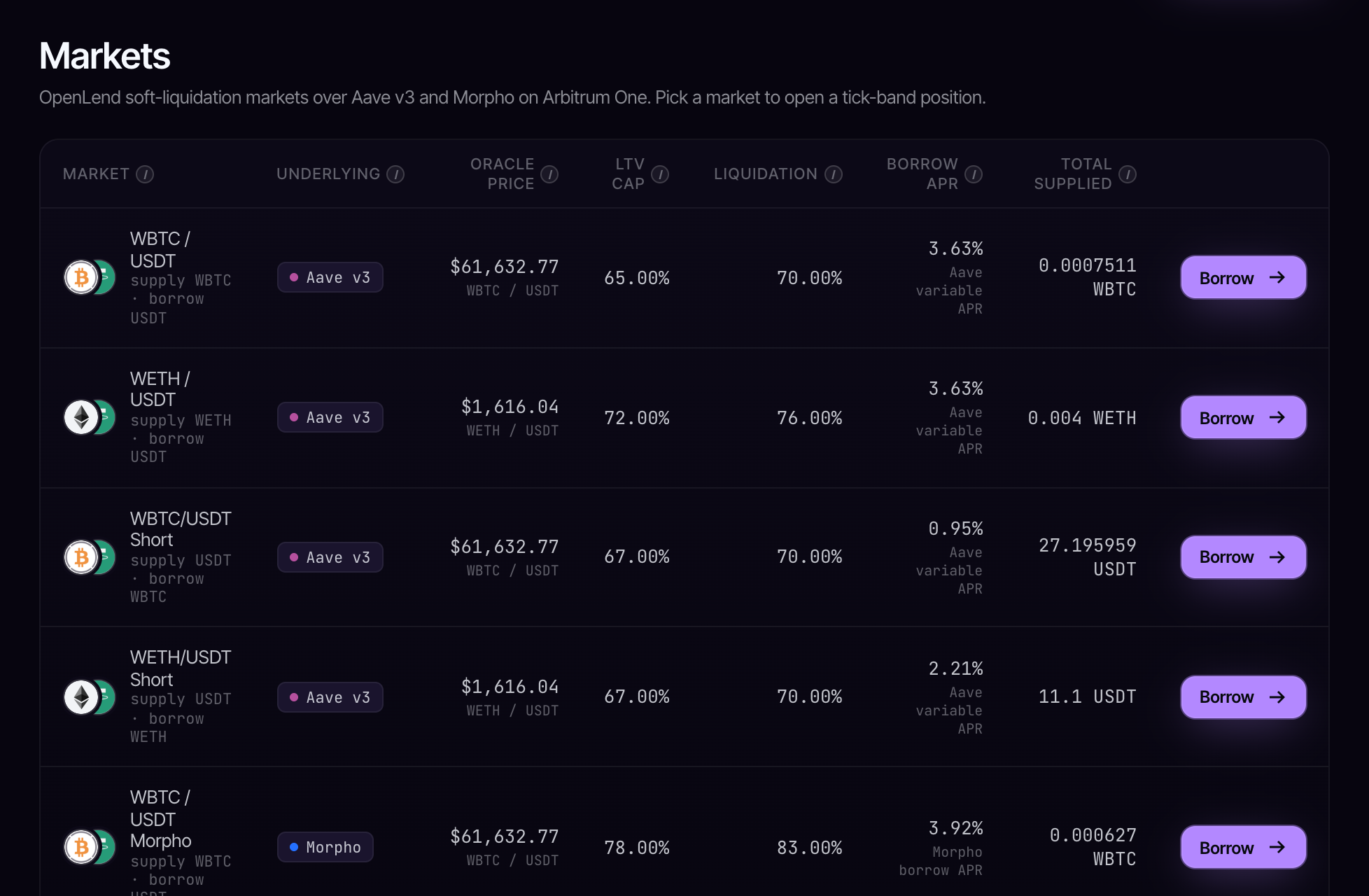
The Markets page now shows the underlying lender for each row, so Aave and Morpho positions can be compared directly. The higher Morpho caps are visible next to the existing Aave long and short markets.
This makes market selection more explicit: users can compare collateral, debt, oracle price, OpenLend LTV cap, hard-liquidation threshold, borrow APR, and supplied collateral before entering the borrow form.
What stays the same
The soft-liquidation model is unchanged. A Morpho OpenLend position still has a tick band below the current oracle price, and solver execution can gradually move exposure through that band before the underlying lender's hard-liquidation threshold becomes relevant.
That means the same core tradeoff still matters. A higher LTV cap can improve capital efficiency, but it does not remove liquidation risk. Users still need to choose a range that gives the system enough room to execute soft liquidation during fast markets and high gas periods.
How to use them
Start from the Markets page and select either WBTC/USDT Morpho or WETH/USDT Morpho. The borrow form will use the selected market configuration, including the Morpho pool, position NFT, collateral token, debt token, and LTV bounds.
For users comparing routes, the practical difference is simple: the Aave markets are still available, while the Morpho long markets offer a higher OpenLend cap for the same long collateral exposure.
Open the Markets page, compare Aave and Morpho rows, and choose the route before opening a tick-band position.