Why looping needs a softer liquidation path
Looping is one of DeFi's most common leverage patterns: supply collateral, borrow against it, buy or mint more of the collateral asset, and supply again. It can turn a simple collateral position into a levered one without leaving the lending market.
The catch is not only that leverage increases risk. The catch is the shape of the risk. In a normal loop, the position can look stable until price crosses a hard threshold, and then the loss event becomes concentrated.
How looping is usually done
A user starts with collateral, for example ETH or BTC. They supply it to Aave, borrow a stablecoin against it, swap the borrowed stablecoin back into more collateral, and supply that collateral again. Repeating this flow creates a larger long exposure to the collateral asset.
The result is economically similar to a leveraged long position. If the collateral price rises, the loop benefits from amplified exposure. If the collateral price falls, the same leverage pushes the position toward liquidation faster than an unlevered borrow.
- Supply collateral to the lending market.
- Borrow a debt asset against that collateral.
- Swap the debt asset back into more collateral.
- Repeat until the target leverage or LTV is reached.
The problem with ordinary looping
The usual loop is close to the liquidation mechanism of the underlying lender. When the position becomes unhealthy, liquidators repay part of the debt and seize collateral with a penalty. That is efficient for the lending market, but it creates a cliff-like payoff profile for the user.
In practice, this means two things. First, the loop often runs near a liquidation boundary because capital efficiency comes from using a high LTV. Second, when liquidation happens, collateral exposure can be reduced sharply at the worst time: during a drawdown.
How OpenLend changes the shape
OpenLend currently uses Aave as the base lending layer, but it places a tick-band controller above the position. The OpenLend market has its own internal LTV cap, set below the underlying hard-liquidation threshold, so the soft-liquidation band has room to work first.
When price moves into the band, solvers can gradually convert collateral exposure into debt-token exposure. If price later recovers, de-liquidation can move the position back in the other direction. Economically, this makes the loop behave less like a cliff and more like a smoother transition region.
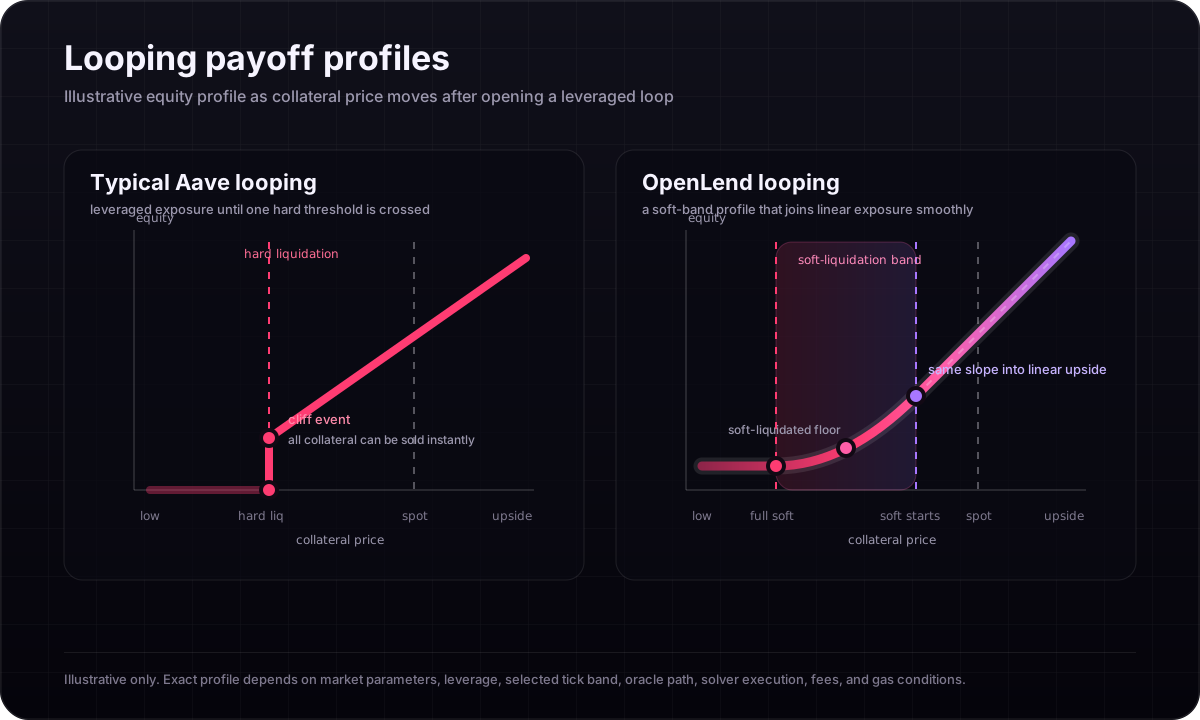
Why the curve matters
The soft-liquidation band is not meant to remove losses. It changes how the position realizes them. Instead of waiting for a single hard-liquidation point, execution can happen across a price interval, with solvers paid by protocol-defined discounts and premiums.
For a looping user, that matters because the position can preserve more readable exposure. The lower side of the profile is softened after the band has done its work, while the upper side still joins back into linear upside exposure if the collateral price recovers.
Solvers make the adjustment executable
OpenLend's soft liquidation is solver-driven. Any valid solver can call the pool when the oracle price and internal cursor create a valid fill opportunity. The solver receives a discount during soft liquidation and a premium during de-liquidation, which makes the trade worth executing against DEX liquidity and gas costs.
This also means execution is not synchronous with a price move. If gas is high or a fill is temporarily unattractive, execution can happen with a delay. OpenLend's internal caps and band design are there to create room for that execution latency.
The accounting stays useful for exposure
Losses associated with soft liquidation and de-liquidation are reflected as a debt-side adjustment, together with borrow interest, rather than simply reducing displayed collateral. That is useful for a looping position because the collateral side can keep representing exposure.
In other words, OpenLend does not make leverage risk disappear. It gives the loop a more explicit liquidation geometry, a softer transition region, and a clearer way to track what the strategy has paid for execution.
Open a position, choose a liquidation band, and inspect how the range changes the risk profile before submitting.